

In our daily consultations for international fertility assistance at Leilawa International, we have encountered many families where the women have experienced two or three early pregnancy miscarriages. They went to the hospital and underwent all possible tests-blood tests for sex hormones, thyroid function, immune system and coagulation factors, as well as examinations of the uterine environment. All the test results showed "no significant abnormalities." The doctors' advice was simply "try again later," but each attempt led to more heartbreak.
What many people don't know is that there's one thing that can be easily overlooked when screening for repeated miscarriages-and this often only involves half of the necessary tests: a chromosome analysis of both partners' peripheral blood. It's not enough to focus only on the woman; sometimes the answer lies in the man's test results.
1. In cases of two miscarriages, the "culprit" isn't the woman.
This is a real case study. The wife was 32 years old, had regular menstrual cycles, normal ovulation, and healthy hormone levels. Both pregnancies progressed smoothly until they stopped in the early stages of pregnancy. Her husband was healthy, and his semen analysis showed no obvious abnormalities.
The turning point came after the second miscarriage: chromosome analysis revealed abnormalities in the embryo's chromosomes. The doctor suggested that both partners undergo a chromosome analysis of their peripheral blood. The result: the wife's chromosome pattern was normal, while her husband had a balanced translocation syndrome, with a chromosome pair of 46,XY.
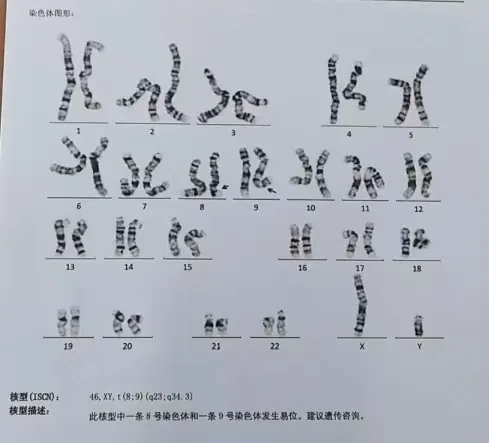
Why couldn't it be detected before?
This is because in individuals with a balanced translocation syndrome, the total number of chromosomes remains unchanged, and the amount of genetic material doesn't increase or decrease. Therefore, they appear healthy in terms of appearance, development, intelligence, and physical health. The problem only becomes apparent during reproduction. Without specialized chromosome analysis, it's almost impossible to detect such conditions during routine pre-pregnancy check-ups.
2. Balanced translocation: Healthy carriers, but "high-risk" groups in terms of reproduction.
If we compare chromosomes to a set of instructions for life, then a balanced translocation is like a "misaligned binding": the total number of pages remains the same (so the carrier appears healthy), but several pages within the chromosomes are misplaced.
The problem lies in the next generation: when carriers produce sperm or eggs, the chromosomes need to be paired and separated. The parts that have changed in structure are likely to be mispaired at this stage. Take transposons, for example. In theory, each reproductive cell's chromosome combination has three possible outcomes:
| Probability (theoretical value) | Result | Implication |
| 1/18 | Normal | The child's chromosomes are completely healthy. |
| 1/18 | Balanced carrier status | The child is as healthy as their carrier parents, but may face similar problems when they become adults. |
| 16/18 | Unbalanced | This is a common cause of miscarriage or fetal death. |
This also explains why many families with balanced translocations experience difficulties. Instead of having trouble getting pregnant, they find it very easy to conceive, but they still struggle to keep the babies alive. Each natural pregnancy seems like a lottery draw. 16/18 of the cases are...
Unfavorable probabilities lead to repeated disappointments.III. Breakthrough Approach: PGT-SR – Turning "Lottery" into "Inspection"
In the third-generation IVF technology, PGT-SR (Preimplantation Genetic Testing for Chromosomal Abnormalities) can be summarized as "inspect first, then proceed with transplantation." Embryos are cultured until the blastocyst stage, and only those with intact chromosomes-either completely normal or carrying chromosomes similar to those of the parents-are selected for transplantation.
Theoretically, only about 12% of embryos are suitable for transplantation. In reality, the proportion of such embryos ranges between 20% and 30%. This leads to a key conclusion: In cycles involving balanced translocation, it's essential to achieve a large number of viable embryos. Only when there are enough candidates can one find a suitable embryo for transplantation. If only five or six eggs are obtained during ovulation induction, it's likely that no suitable embryo will be found after screening. Therefore, personalized ovulation induction plans combined with advanced blastocyst culture capabilities are crucial in this process.
IV. Our Data: One Ovulation Induction, One Transplantation, and Twins
| Stage | Result |
| Ovum Collection | 19 ovum collected (15 mature) |
| Fertilization | 13 eggs fertilized via ICSI |
| Blastocyst Culture | 9 blastocysts developed (5 days × 6 days, 3 days × 3 days) |
|
PGT-SR screening results:
Two embryos were considered "normal", and one was a balanced carrier.
After transplantation, two normal embryos were implanted, resulting in a successful twin birth. Final outcome: The pregnancy lasted for 38 weeks and 3 days, and both twins were born safely.
The success rate of transplantation was approximately 33%. This cycle was quite successful. The balanced carrier embryo remains healthy and is stored frozen for future use.
5. Recommendations for families with recurrent miscarriages For screening for recurrent miscarriages, it is recommended to follow this order: ① Embryo level: Chromosome analysis of the miscarriage tissue/chorion – identify the exact cause of the problem in this pregnancy. ② Both partners' karyotypes: Peripheral blood chromosome analysis, involving both partners. Don't only test the mother. ③ Maternal factors: Uterine environment, endocrine system, immune function, thyroid function, etc. ④ Male semen quality: Routine tests plus DNA fragmentation rate. ⑤ Make a decision after clarifying the issues: Plan for natural conception. + Strict prenatal diagnosis, or IVF + PGT-SR. It is recommended to consult a genetic counselor for more information.If one of the partners is identified as a carrier of balanced translocation, there is no need for despair-just like in this case: the father was a carrier, but their family still had two healthy children. Once the right direction is chosen, the path becomes clear. The consultants at Leilawa International Fertility can match couples with centers and doctors experienced in PGT-SR based on their test results, ensuring that every attempt at fertilization and every embryo used are utilized effectively. 6. Frequently Asked Questions (FAQ) Q1: Both my spouse and I are healthy, and there are no genetic disorders in our family. Why do we still need to undergo chromosome analysis? Carriers of balanced translocations are generally completely healthy. Most cases involve newly discovered carriers or those who have not been detected in previous generations. Regular physical examinations cannot detect these conditions. For families with repeated miscarriages, failed attempts at conception, or children with chromosomal abnormalities, chromosome analysis is highly recommended, and both spouses should undergo the test together. Q2: If I am diagnosed with balanced translocation, can I still conceive naturally? No. Even if a carrier conceives, there is still about a 1/18 chance that the pregnancy will be normal, and a 1/18 chance that the fetus will also be a carrier. Families with young children and fewer miscarriages can try natural conception under the guidance of a doctor, along with strict prenatal monitoring. For families who have experienced multiple miscarriages or wish to screen for potential issues from the beginning, IVF + PGT-SR may be an option. The choice of method should be made based on the advice of a genetic counselor. Q3: Can PGT-SR ensure that the baby is completely healthy? PGT-SR targets chromosomal structural abnormalities and can significantly reduce the risk of miscarriage caused by unbalanced translocations. However, it cannot replace prenatal diagnosis-regular prenatal check-ups and necessary prenatal tests must still be carried out according to medical advice. The two methods complement each other. Q4: What kind of assistance can Leilawa provide during PGT-SR procedures abroad? Leilawa International Fertility is responsible for initial consultations and matching couples with centers and doctors experienced in PGT-SR, based on their test results. The cooperative hospitals will match up the appropriate reproductive centers and doctors, ensuring that the entire process of seeking medical treatment abroad is handled smoothly. The medical plan is formulated by the reproductive doctors who receive patients. Families with a history of repeated miscarriages often have limited time at their disposal. Therefore, it's important to conduct thorough evaluations and prepare necessary documents in advance, so as to avoid unnecessary complications.For more on fertility preparation, second/third-generation IVF, and overseas, U.S., Thailand, Malaysia, America or Cambodia IVF, scan the QR code on the right or call lelaiwa's hotline+852 6145 8043! Quick Links Service Hours WeChat Official  |
 Address: Beijing City Yili Ecological Plaza
 WeChat: lelaiwa2008
 Phone: +852 6145 8043